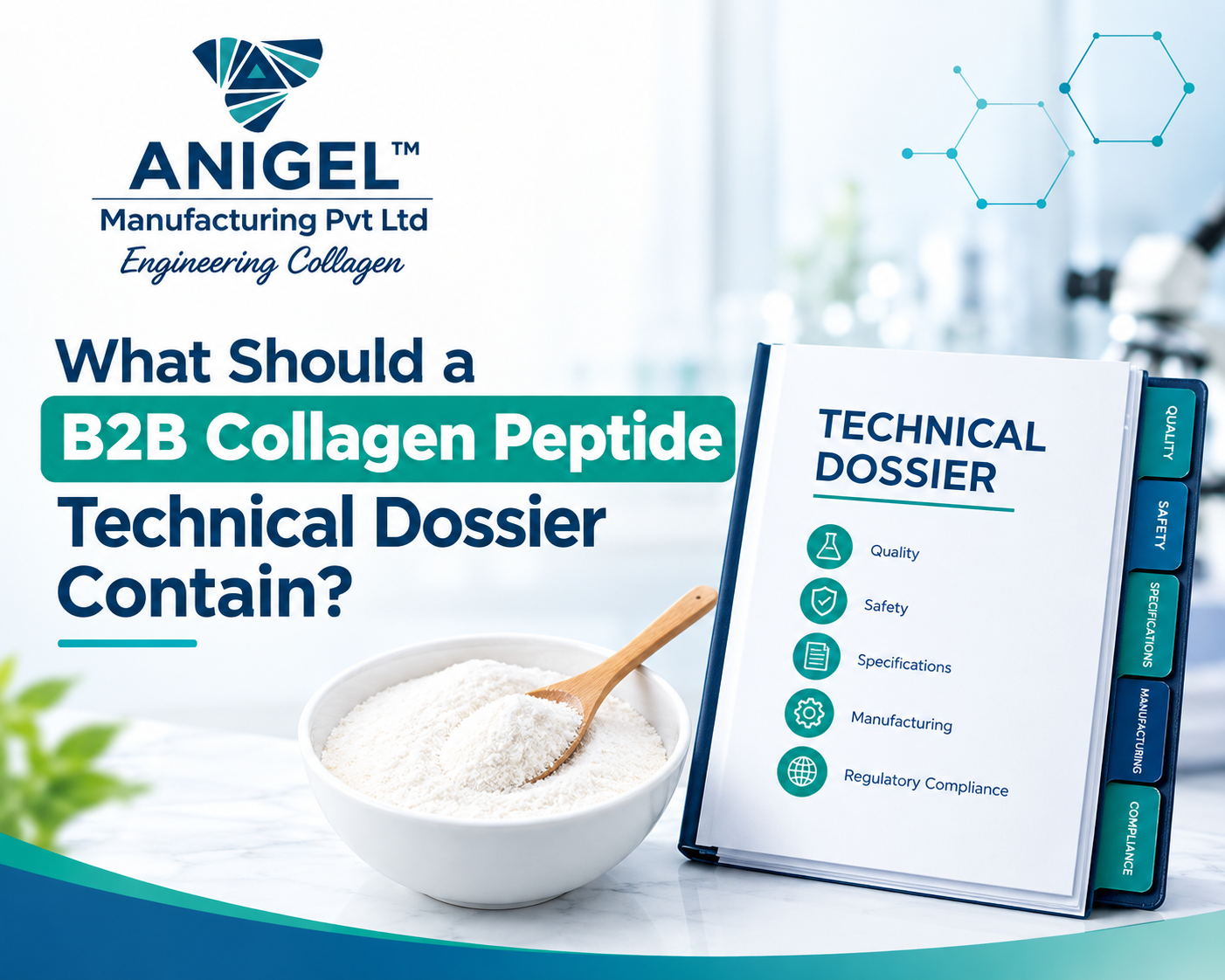
Introduction: Why a Technical Dossier Matters in B2B Collagen Peptide Procurement?
Selecting a collagen peptide supplier requires more than comparing price, protein content, or minimum order quantities. For R&D teams, procurement professionals, formulators, QA teams, and B2B ingredient buyers, a technical dossier provides the information needed to assess product quality, suitability, consistency, safety, and supply reliability.
A well-prepared collagen peptide technical dossier should cover product identity, source, manufacturing process, quality specifications, safety testing, traceability, certifications, and supporting regulatory documents. It should provide sufficient technical evidence for supplier qualification and internal review.
Because collagen peptides are complex mixtures, characteristics can be influenced by raw-material source, processing, hydrolysis, purification, and manufacturing controls. Therefore, buyers should evaluate the complete technical profile rather than relying on a single specification.
In B2B procurement, a technical dossier is more than a collection of certificates—it is an evidence package for evaluating a collagen peptide supplier.
What Is a Collagen Peptide Technical Dossier?
A collagen peptide technical dossier is a collection of product details, manufacturing aspects, quality parameters, safety aspects, regulatory requirements, and supporting technical documents provided by a collagen peptide manufacturer or supplier.
It should help buyers answer key questions:
- What is the product?
- What is its source?
- How is it manufactured?
- What specifications does it meet?
- How is quality controlled and maintained?
- What safety testing is performed?
- What certifications and regulatory documents are available?
- What are the intended applications?
The exact documentation may vary according to the product, application, destination market, and regulatory requirements.
1. Product Identification, Source and Intended Applications
The dossier should clearly identify the collagen peptide being evaluated.
Key information should include:
- Product name and grade
- Product code
- Ingredient description
- Physical form
- Source material
- Animal species, where applicable
- Manufacturing origin
- Intended applications
- Storage conditions
- Packaging
- Shelf life
Source transparency is particularly important for B2B buyers because formulation, market, certification, and customer requirements may differ.
The dossier should distinguish the collagen source from the technology used to manufacture the final collagen peptide.
It should also identify relevant applications, such as nutraceuticals, functional foods and beverages, sports nutrition, beauty and wellness, and joint- and bone-health formulations.
2. Manufacturing Process and Quality-Control Information
A technical dossier should provide an appropriate overview of the collagen peptide manufacturing process without necessarily disclosing proprietary process parameters.
Depending on the manufacturer, the process overview may cover:
- Raw-material selection
- Pre-treatment
- Outline of extraction process
- Outline of purification and downstream processes
- Packaging
- Finished-product testing
The important consideration for buyers is whether the manufacturing process is controlled, documented, reproducible, and supported by appropriate quality controls.
Controlled hydrolysis can influence peptide-size distribution, making process consistency relevant when evaluating collagen peptide quality.
3. Key Quality and Physicochemical Specifications
A reliable dossier should provide a clear product specification with defined acceptance criteria and, where relevant, analytical methods.
Protein Purity
Protein content is an important quality parameter, but it should not be considered in isolation.
Buyers should verify:
- Minimum protein content
- Analytical method
- Acceptance range
- Batch-to-batch consistency
- Applicability to the specific product grade
A high protein value alone does not provide a complete picture of ingredient quality.
Molecular-Weight Distribution
Molecular-weight distribution is an important characteristic of collagen peptides because they contain peptide populations of different sizes.
The dossier should ideally indicate:
- Target molecular-weight distribution
- Analytical technique
- Reporting method
- Acceptance criteria
- Batch monitoring approach
This information can help R&D teams evaluate the consistency of the ingredient and its suitability for formulation requirements.
Amino Acid Profile
The amino acid profile provides additional information about collagen peptide composition.
Where relevant, the dossier should provide quantitative information for key amino acids. This allows R&D teams to compare the ingredient against technical and formulation requirements.
Moisture, Ash, pH and Solubility
Other physicochemical parameters may include:
- Moisture
- Ash
- pH
- Solubility
- Appearance
- Color
- Odor
- Bulk density, where relevant
These characteristics can influence ingredient handling, processing, and formulation performance, particularly in powders, beverages, and nutritional products.
4. Microbiological, Heavy-Metal and Contaminant Testing
Safety-related documentation is a critical part of collagen peptide supplier qualification.
Depending on the product and market, buyers may need to review:
- Total microbial count
- Yeast and mold
- Relevant pathogens
- Heavy metals
- Pesticide residues, where applicable
- Other relevant contaminants
- Foreign-material controls
The applicable testing requirements depend on the product, intended use, destination market, and regulatory framework.
For procurement and QA teams, the key question is whether relevant testing is defined, appropriately performed, documented, and linked to established specifications.
5. Batch Consistency, Traceability and Quality Assurance
A strong technical dossier should demonstrate how the manufacturer maintains batch-to-batch consistency.
Buyers should look for information related to:
- Batch and lot identification
- Raw-material traceability
- Manufacturing records
- Finished-product testing
- Retention samples
- Deviation management
- Change control
- Complaint handling
- Corrective and preventive actions, where applicable
Traceability connects the finished collagen peptide with its manufacturing and quality records.
Therefore, buyers should ask not only, “Does this batch meet specification?”, but also, “Does the supplier have a system that consistently produces batches meeting specification?”
6. Certificates, Regulatory and Supporting Technical Documents
A complete dossier may contain several supporting documents.
Certificate of Analysis (CoA)
A Certificate of Analysis provides batch-specific test results against established specifications.
A CoA should typically identify:
- Product
- Batch or lot number
- Relevant test parameters
- Specification limits
- Actual results
- Analytical methods, where applicable
- Testing or approval information
The CoA should be reviewed together with the master product specification rather than used as its replacement.
Product Specifications
The specification establishes the defined quality requirements for the ingredient and provides the benchmark for evaluating individual batches.
Certifications
Depending on product and market requirements, relevant certifications may include:
- FSSC 22000
- HACCP
- Halal
- Kosher
- ISO-related certifications
- Other applicable food-safety or quality certifications
Buyers should verify certification validity, scope, and applicability.
SDS and Supporting Declarations
Depending on requirements, supporting documentation may include:
- SDS
- Allergen declaration
- GMO declaration
- BSE/TSE statement, where applicable
- Origin declaration
- Animal-origin declaration
- Non-irradiation declaration, where applicable
- Regulatory statements
- Storage and handling information
Not every document is required for every collagen peptide; requirements should be determined based on the product and target market.
7. How R&D and Procurement Teams Should Evaluate a Technical Dossier
Receiving a dossier is only the beginning. Teams should review it systematically.
What should buyers verify?
- Product identity: Does the documentation match the ingredient being purchased?
- Source: Is the source clearly identified and suitable for the intended application?
- Specifications: Are the parameters quantitative and supported by appropriate methods?
- Molecular-weight profile: Is the peptide distribution defined and monitored?
- Safety: Are microbiological and contaminant controls appropriate?
- Batch consistency: Can the supplier demonstrate reproducible quality?
- Documentation: Are the documents complete, consistent, and current?
- Certifications: Are certificates valid and relevant to the destination market?
- Traceability: Can raw materials and finished batches be traced?
- Change control: Does the supplier have a formal process for managing and communicating significant changes?
A structured review helps buyers distinguish between suppliers that simply provide documents and those with robust quality systems.
8. Common Documentation Gaps
Several documentation gaps can delay or complicate supplier qualification.
Common examples include:
- Generic product specifications
- Missing analytical methods
- Undefined molecular-weight distribution
- Incomplete contaminant testing
- Outdated certificates
- CoAs without clear specification limits
- Inconsistent product names across documents
- Limited source information
- Incomplete traceability
- Certifications without clear scope
- No documented change-control process
These gaps do not automatically make an ingredient unsuitable, but they should prompt clarification before qualification.
9. Supplier Qualification Considerations
A technical dossier should form part of a broader collagen peptide supplier qualification process.
Procurement and QA teams may also evaluate:
- Manufacturing capacity
- Minimum order quantities
- Lead times
- Supply continuity
- Quality-management systems
- Technical support
- Regulatory support
- Complaint handling
- Change notification
- Packaging and logistics
- Experience serving international markets
A reliable B2B supplier should demonstrate not only technical product quality but also the capability to maintain consistent quality, traceability, documentation, and supply reliability over time.
Conclusion
A B2B collagen peptide technical dossier should provide a clear technical overview of the ingredient—from product identity and source to manufacturing controls, specifications, safety testing, traceability, certifications, and regulatory documentation.
For R&D teams, it supports formulation assessment. For procurement teams, it enables structured supplier comparison. For QA teams, it provides evidence for quality and compliance evaluation.
The most effective approach is to assess the complete technical profile rather than focusing on a single parameter such as protein content or price.
Ultimately, a well-structured dossier helps B2B buyers make a more informed decision when qualifying a collagen peptide supplier.
FAQs
What should a collagen peptide technical dossier contain?
It should generally include product identification, source, intended applications, manufacturing overview, specifications, analytical information, safety testing, CoA, certifications, regulatory declarations, and relevant supporting documents.
Why is molecular-weight distribution important in collagen peptides?
It provides information about the peptide-size profile and can help R&D teams evaluate product consistency and manufacturing control.
Is a CoA enough to qualify a collagen peptide supplier?
No. A CoA provides batch-specific results, while supplier qualification should also consider specifications, manufacturing controls, traceability, certifications, quality systems, and supporting documentation.
What safety tests should buyers review?
Depending on the product and market, buyers should review relevant microbiological testing, heavy-metal testing, and other applicable contaminant controls.
What should procurement teams look for in a collagen peptide supplier?
They should evaluate technical quality alongside manufacturing capacity, supply continuity, documentation, certifications, traceability, lead times, change-control practices, and technical support.
Why is batch-to-batch consistency important?
Consistent raw materials help formulators achieve predictable processing and finished-product characteristics, making demonstrated batch consistency an important supplier-qualification consideration.
Should every collagen peptide supplier provide the same documents?
No. Documentation requirements depend on the ingredient, application, destination market, and applicable regulatory requirements.