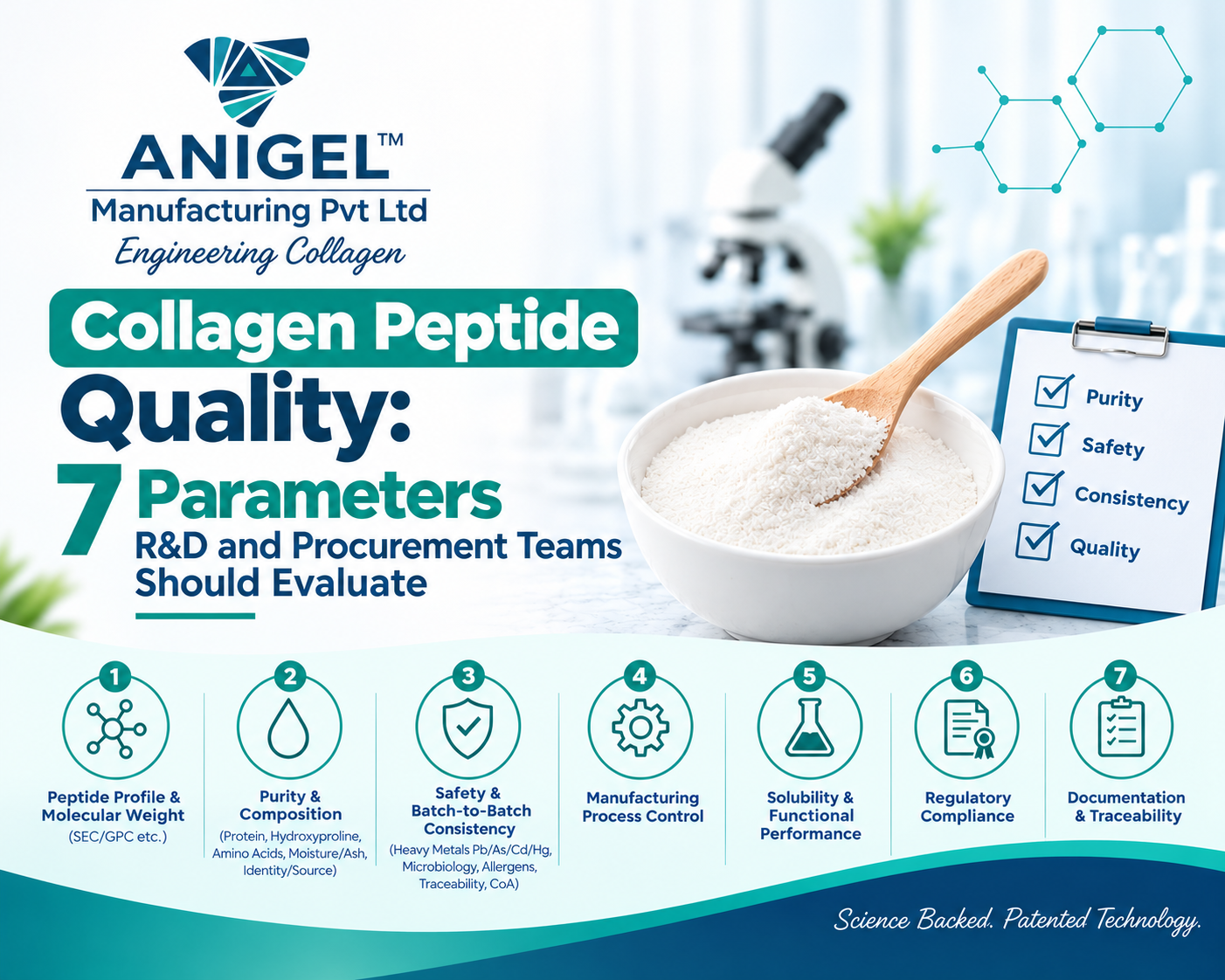
Introduction: Why Collagen Peptide Quality Matters
Choosing a collagen peptide supplier is about more than price or protein content. For B2B manufacturers, ingredient quality can influence formulation performance, sensory characteristics, consistency, and product reliability. That is why R&D and procurement teams need to look beyond a Certificate of Analysis (CoA) and understand how consistently a supplier can meet defined quality requirements. So, what should buyers evaluate when assessing collagen peptide quality? This article explores the key quality parameters that can help businesses make more informed supplier and ingredient decisions.
What Defines High-Quality Collagen Peptides?
High-quality collagen peptides should demonstrate consistent compositional, microbiological, physicochemical, and sensory characteristics appropriate for their intended application.
While specific acceptance criteria depend on the product specification and end-use, a robust quality evaluation typically considers:
- Protein content and purity
- Molecular-weight distribution
- Amino acid profile
- Microbiological quality
- Physicochemical properties
- Organoleptic properties
- Heavy metals and contaminant control
- Batch-to-batch consistency
Evaluating these parameters together gives buyers a more complete understanding of collagen peptide quality than relying on a single specification or test result.
1. Protein Content and Purity
Protein content is one of the first parameters buyers typically review when assessing collagen peptide purity. A suitable collagen peptide ingredient should meet its defined protein specification consistently across batches. However, protein percentage alone does not provide a complete picture of ingredient quality. R&D teams should also consider the analytical method used, specification limits, moisture content, ash, and other relevant characteristics when interpreting test results.
Total nitrogen is estimated and protein content is calculated multiplying the total with the multiplying factor. Though, 6.25 is the conversion factor generally used, it is not ideal for collagen. The appropriate conversion factor for collagen is 5.56. Kjeldahl method, and Dumas combustion are popularly followed for estimating total nitrogen. Whereas Kjeldahl method is suitable for routine QC, Dumas combustion is faster and precise. Lowry procedure for estimating the protein is not suitable for collagen. Hydroxyproline assay provides a clear estimate eof collagen.
For procurement teams, the important question is whether the supplier has clearly defined specifications and reliable quality-control procedures to maintain them. A supplier capable of consistently meeting agreed specifications provides greater confidence for formulation development and commercial-scale production.
2. Molecular-Weight Distribution
Molecular-weight distribution is an important collagen peptide quality parameter, particularly because peptide size can influence functional and formulation characteristics. Instead of considering only an average molecular weight, R&D teams should review the distribution profile and understand how it is controlled during enzymatic hydrolysis and downstream processing.
Manufacturing conditions can influence peptide-chain characteristics. Therefore, buyers should ask suppliers:
- How is molecular weight estimated?
- What analytical method is used?
- What is the defined molecular-weight specification?
- How consistently is the target distribution achieved?
For formulators developing products across beverages, powders, capsules, and other formats, understanding molecular-weight characteristics can support more predictable formulation decisions.
3. Amino Acid Profile
The amino acid composition is another important consideration when evaluating collagen peptide quality. Collagen is characterized by its distinctive amino acid composition, including substantial levels of glycine, proline, and hydroxyproline. An amino acid profile can help provide additional information about the identity and composition of a collagen peptide ingredient. Estimation of the amino acids such as Glycine, Proline, Hydroxyproline, Glutamic acid, Alanine, Arginine , Aspartic acid, Lysine is extremely valuable for verifying that the material is genuinely collagen-derived.
For B2B buyers, reviewing amino acid data alongside other quality parameters can strengthen supplier qualification and incoming-material assessment. R&D teams may also use amino acid-profile information when comparing materials from different suppliers or establishing internal specifications for a formulation.
4. Microbiological Quality
Microbiological quality is essential for ingredients intended for food, nutraceutical, and supplement applications. Typical microbiological evaluations may include parameters such as total microbial counts, yeast and mould, and specified pathogens according to the applicable product specification and regulatory requirements.
A supplier's microbiological control strategy should extend beyond final-product testing. It should include appropriate raw-material controls, hygienic manufacturing practices, process controls, environmental controls where applicable, and validated or qualified testing procedures. When evaluating a collagen peptide manufacturer, procurement and quality teams should therefore examine both the analytical results and the systems used to achieve them.
5. Physicochemical Properties
Physicochemical properties provide important information about how collagen peptides behave as an ingredient during manufacturing and formulation. These characteristics can affect handling, processing, dispersion, and compatibility with different product formats. R&D teams should therefore evaluate physicochemical properties according to the intended application rather than relying on a generic specification.
Depending on the application, relevant parameters may include:
- Moisture content
- Ash
- pH
- Solubility
- Particle characteristics
- Bulk density
- Appearance
6. Organoleptic Properties
Organoleptic properties are an important but sometimes overlooked part of collagen peptide quality. For manufacturers developing consumer-facing products, sensory characteristics can directly affect formulation decisions. An ingredient with an undesirable odor, noticeable taste, or inconsistent appearance may create additional challenges during product development, particularly in beverages and other products where flavor and sensory experience are critical.
These properties describe characteristics that can be assessed through the senses, including:
- Color
- Odor
- Taste
- Appearance
R&D teams can establish internal sensory specifications and compare incoming batches against approved standards. Procurement teams can then use these specifications as part of supplier qualification and ongoing quality monitoring. Organoleptic evaluation should complement, rather than replace, instrumental and laboratory testing.
Why a Certificate of Analysis (CoA) Is Not Enough
A Certificate of Analysis is an important document, but it should not be the only basis for collagen peptide supplier evaluation. A CoA provides analytical results for a particular batch. It does not necessarily demonstrate the strength of the supplier's complete quality-management system.
B2B buyers should also evaluate:
- Manufacturing controls
- Raw-material sourcing and traceability
- Testing methods
- Quality specifications
- Certifications and regulatory compliance
- Batch history
- Technical support
- Change-control procedures
- Complaint and deviation-management processes
How Should R&D Teams Evaluate Collagen Peptide Quality?
R&D teams should begin by defining the technical requirements of the intended application. These may include target molecular-weight characteristics, solubility, sensory properties, protein content, microbiological requirements, and other formulation-specific criteria. The next step is to request representative samples and technical documentation from potential suppliers.
A practical evaluation process can include:
- Define application-specific specifications.
- Review technical documentation and CoAs.
- Evaluate representative samples.
- Assess physicochemical and organoleptic properties.
- Compare multiple batches where possible.
- Conduct formulation trials.
- Review manufacturing and quality-control systems.
- Approve suppliers based on both technical and commercial suitability.
What Should Procurement Teams Check Before Selecting a Supplier?
Procurement teams should consider more than price and availability when selecting a bulk collagen peptide supplier. A technically strong supplier that can provide consistent quality, reliable documentation, and transparent communication may offer greater long-term value than a supplier selected solely on initial cost.
Key questions include:
- Can the supplier consistently meet agreed specifications?
- Is raw-material traceability established?
- What quality certifications are maintained?
- How are batches tested and released?
- What is the supplier's change-control process?
- Can the supplier provide technical documentation?
- What is the supplier's production capacity?
- How does the supplier manage deviations and complaints?
- Can the supplier support long-term supply requirements?
How Anigel Manufacturing Ensures Consistent Collagen Peptide Quality
For Anigel Manufacturing Pvt. Ltd., quality begins with a controlled manufacturing approach and extends throughout the production and testing process. The entire manufacturing process, right from preparation of the raw material (bovine hides or fish skins or demineralized fish scales) to hydrolysis to downstream process is completely organic and no chemical is used. The company focuses on controlled collagen peptide manufacturing, quality testing, traceability, and consistent production parameters to meet B2B customer requirements. First the quality of the incoming material is verified, then the quality of the intermittent product (prepared hides or skins or scales) is checked and finally the quality of the final product (spray dried powder or granulated product) is verified.
Anigel's approach is designed around the principle that consistent-quality collagen peptides require more than final-product testing. Raw-material controls, process management, analytical evaluation, documentation, and batch traceability all contribute to maintaining defined product specifications. Its manufacturing approach is also supported by science-driven technology and a focus on quality systems relevant to B2B ingredient supply. For R&D teams, this provides a framework for evaluating collagen peptides based on measurable quality characteristics. For procurement teams, it supports supplier qualification by providing greater visibility into manufacturing and quality-control practices.
Frequently Asked Questions About Collagen Peptide Quality
What are the most important collagen peptide quality parameters?
Key parameters include protein content and purity, molecular-weight distribution, amino acid profile, microbiological quality, physicochemical properties, organoleptic properties, contaminant control, and batch-to-batch consistency.
Why is molecular weight important in collagen peptides?
Molecular-weight distribution provides information about peptide size characteristics and can be relevant to formulation and product development. Buyers should evaluate the distribution profile and the analytical method used by the supplier.
What are organoleptic properties of collagen peptides?
Organoleptic properties include sensory characteristics such as color, odor, taste, and appearance. These characteristics can be particularly relevant when collagen peptides are used in consumer-facing formulations.
Is a CoA enough to evaluate a collagen peptide supplier?
No. A CoA is useful for verifying batch-specific analytical results, but supplier evaluation should also consider manufacturing controls, traceability, testing systems, certifications, consistency, and technical support.
How can buyers compare collagen peptide suppliers?
Buyers should compare suppliers against a standardized specification covering quality parameters, testing, certifications, traceability, manufacturing controls, batch consistency, documentation, technical support, and commercial requirements.