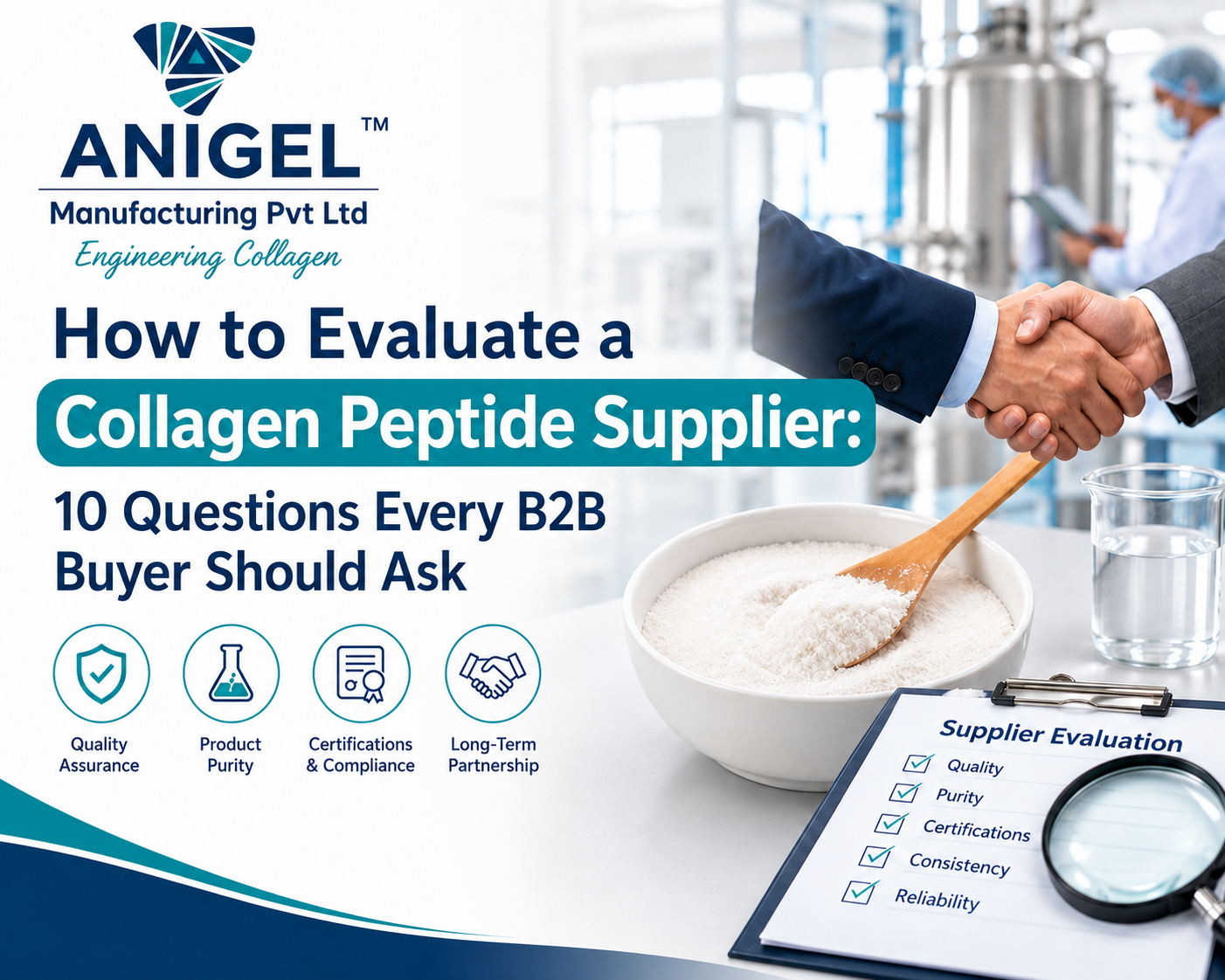
Introduction: Why Choosing the Right Collagen Peptide Supplier Matters
Collagen peptides are used across a growing range of applications, including dietary supplements, functional foods and beverages, sports and wellness nutrition, beauty-from-within formulations, and pet nutrition. However, not all collagen peptide ingredients are the same. Differences in raw material sourcing, manufacturing processes, molecular characteristics, quality control testing procedures, and application suitability can affect the final product. A reliable supplier should therefore offer more than a collagen peptide ingredient. B2B buyers should look for a partner with defined quality systems, transparent documentation, consistent manufacturing practices, and the technical capability to support their intended application.
This article outlines the key questions B2B buyers should ask when selecting a collagen peptide supplier. It also highlights how a manufacturing-focused approach, such as that adopted by Anigel Manufacturing Pvt. Ltd., can help address the requirements of modern nutraceutical, functional food, and global ingredient markets.
What Should B2B Buyers Look for When Evaluating a Collagen Peptide Supplier?
A reliable collagen peptide supplier should be evaluated across multiple criteria rather than on price alone. Here are the following key factors:
- Raw material source and traceability
- Manufacturing technology and process control
- Product quality specifications
- Batch-to-batch consistency
- Food safety and quality management systems
- Purity and safety testing
- Certifications and documentation
- Application suitability
- Technical support
- Production and supply capabilities
The most effective approach is to evaluate what a supplier does, how consistently it delivers, and whether its collagen peptides are suited to the buyer's specific applications. For Anigel, this buyer-focused approach is reflected in its focus on advanced collagen peptide manufacturing, consistent quality, application suitability, and manufacturing technology.
What is the Source and Quality of the Raw Materials?
The quality of collagen peptides begins with the raw materials used in production. Buyers should understand the source of the material and evaluate the supplier's approach to traceability and incoming quality control.
Key questions include:
- Is the raw material source documented?
- Are appropriate traceability systems in place?
- How are incoming materials evaluated?
- Are materials assessed against defined quality specifications?
Strong raw material controls provide the foundation for consistent finished-product quality and are particularly important for companies serving regulated or international markets.
How are the Collagen Peptides Manufactured?
The manufacturing process can influence important collagen peptide characteristics, including molecular properties, solubility, sensory characteristics, and overall consistency. Buyers should look beyond the final specification sheet and ask how hydrolysis, processing, drying, and critical quality parameters are controlled. At Anigel Manufacturing Pvt.Ltd., collagen peptides are produced using technology licensed from CSIR-CLRI, supporting a technology-driven approach to collagen peptide manufacturing. Controlled manufacturing processes are important because they can contribute to predictable product characteristics and reliable batch performance.
What Quality Specifications Should You Check?
A complete product specification should be reviewed before supplier approval. Depending on the application, relevant parameters may include:
- Protein content
- Moisture and ash
- Solubility
- Molecular characteristics, where relevant
- Appearance and sensory characteristics
- Microbiological specifications
- Heavy metal limits
Buyers should not evaluate collagen peptides based on a single parameter such as protein content. The complete specification should match the requirements of the finished product. Anigel focuses on collagen peptides with characteristics such as high purity, neutral taste, and odourless properties, supporting formulation requirements across multiple B2B applications.
How Does the Supplier Ensure Batch-to-Batch Consistency?
Consistency is important for commercial-scale manufacturing. Variations between batches can affect formulation performance, processing behaviour, sensory properties, and the quality of the final product. Buyers should ask whether critical quality attributes are defined, batches are evaluated against specifications, manufacturing parameters are controlled, and deviations are documented and investigated.
At Anigel, batch consistency is supported through a quality-focused manufacturing approach and controlled processes designed to maintain reliable product characteristics across production batches.
What are the Food Safety Certifications and Quality Standards Does the Supplier Follow?
Certifications should be evaluated based on their validity, scope, and relevance to the target market. Anigel's relevant certifications and registrations include FSSC 22000, Halal, Kosher, FSSAI, and US FDA facility registration. Buyers should always review current certificates and confirm their relevance to their specific market requirements. It is also important to understand that US FDA facility registration is not the same as FDA product approval.
How Are Collagen Peptides Tested for Purity and Safety?
Testing is a critical part of ingredient quality assurance. Depending on the specification and application, testing may include protein, moisture, ash, microbiological parameters, heavy metals, and other relevant quality characteristics.
Buyers should confirm:
- What parameters are tested
- Whether batches are evaluated against specifications
- Whether Certificates of Analysis are available
- How non-conforming material is handled
Clear testing and quality documentation are particularly important for procurement and quality teams during supplier qualification.
Are the Collagen Peptides Suitable for Your Specific Application?
A collagen peptide that meets general specifications may not necessarily be suitable for every formulation. Application requirements can vary significantly. Beverage formulations may prioritize solubility and sensory characteristics, while other products may focus on compatibility, processing, or dispersibility. Here are the following applications:
- Nutraceuticals and dietary supplements
- Functional foods and beverages
- Protein and wellness nutrition
- Sports nutrition
- Beauty-from-within products
- Pet food and animal nutrition
- Functional pet treats and supplements
At Anigel's, we focus on high purity, neutral taste, and odourless characteristics that can support formulation across nutrition, wellness, functional food, and pet nutrition applications.
Can the Supplier Support Long-Term Supply Requirements?
A supplier must be able to support both current and future production requirements. Buyers should consider manufacturing capability, lead times, raw material availability, scalability, production planning, and export documentation. For growing brands, a reliable long-term supplier can provide greater value than a lower-cost supplier that cannot consistently support future demand.
Anigel's manufacturing-focused approach is designed to support B2B collagen peptide requirements across nutrition, functional food, wellness, and related applications. Specific volume and export requirements should be discussed during supplier qualification.
Does the Supplier Offer Transparency and Technical Support?
B2B buyers often need support beyond ingredient supply. This may include product information, quality documentation, samples, application guidance, and assistance during supplier qualification. Transparency is especially important when buyers need to understand how an ingredient is manufactured, tested, and controlled.
Anigel aims to support customers with both collagen peptide ingredients and the technical and quality information needed to evaluate their suitability for specific applications. This collaborative approach can support better-informed decisions across procurement, formulation, and R&D teams.
Collagen Peptide Supplier Evaluation Checklist for B2B Buyers
A structured checklist helps buyers evaluate suppliers based on factors that affect product quality, manufacturing efficiency, and supply reliability. Before selecting a supplier, confirm:
- Raw materials are documented and traceable.
- The supplier can support long-term production requirements.
- Technical and quality support are available.
- Manufacturing processes are controlled.
- Product specifications meet application requirements.
- Batch-to-batch consistency is supported by quality controls.
- Relevant food safety certifications are available.
- Purity and safety testing are documented.
- Certificates of Analysis are available.
- The ingredient is suitable for the intended application.
- Required technical and regulatory documentation can be provided.
Why Choose Anigel Manufacturing Pvt. Ltd. for Collagen Peptides?
For B2B buyers, supplier selection requires confidence in manufacturing technology, quality systems, consistency, documentation, and application suitability. Anigel Manufacturing Pvt. Ltd. offers a manufacturing-focused approach to collagen peptides built around:
- Technology-driven manufacturing: Technology licensed from CSIR-CLRI.
- Quality and consistency: Controlled manufacturing and quality-focused processes.
- Formulation-friendly characteristics: High purity, neutral taste, and odourless properties.
- Relevant certifications: FSSC 22000, Halal, Kosher, FSSAI, and US FDA facility registration.
- Broad B2B application focus: Nutraceuticals, functional foods and beverages, protein and wellness nutrition, sports nutrition, and pet nutrition.
For buyers seeking a collagen peptide manufacturing partner, Anigel provides a combination of technology, quality-focused manufacturing, and application-oriented support. Final supplier qualification should always be based on current specifications, certifications, documentation, samples, and the buyer's specific application requirements.
Frequently Asked Questions
1. What should B2B buyers look for in a collagen peptide supplier?
Buyers should assess raw material traceability, manufacturing technology, collagen peptide quality, batch consistency, testing, certifications, technical support, and supply capacity.
2. How do you choose a collagen peptide supplier?
When considering how to choose a collagen peptide supplier, evaluate manufacturing processes, specifications, quality controls, certifications, application suitability, documentation, and long-term supply capability.
3. What makes Anigel a reliable collagen peptide manufacturer?
Anigel Manufacturing Pvt. Ltd. uses technology licensed from CSIR-CLRI and focuses on controlled manufacturing, consistent quality, high purity, neutral taste, and odourless collagen peptides.
4. What certifications does Anigel have for collagen peptide manufacturing?
Anigel's relevant certifications and registrations include FSSC 22000, Halal, Kosher, FSSAI, and US FDA facility registration, subject to current certification scope and validity.
5. How does Anigel maintain collagen peptide quality and consistency?
Anigel follows controlled manufacturing and quality-focused processes to support consistent product characteristics and batch-to-batch reliability.
6. What applications are Anigel collagen peptides suitable for?
Anigel collagen peptides are positioned for nutraceuticals, functional foods and beverages, sports and wellness nutrition, beauty-from-within products, and pet nutrition, depending on application requirements.
7. Does Anigel supply collagen peptides in bulk?
Yes. Anigel supports B2B requirements and can discuss bulk collagen peptide supplier requirements such as volume, packaging, specifications, lead times, and export needs.
8. Why consider a collagen peptide manufacturer in India?
A collagen peptide manufacturer in India can offer manufacturing capability, scalability, supply flexibility, and technical support. Buyers should evaluate the supplier based on quality, consistency, documentation, and application suitability.
9. What documents should buyers request from a collagen peptide supplier?
Buyers should request product specifications, Certificates of Analysis, certifications, testing information, technical documents, traceability information, and applicable regulatory documentation.
10. Why is collagen peptide supplier evaluation important?
A structured collagen peptide supplier evaluation helps B2B buyers compare suppliers based on quality, manufacturing controls, certifications, consistency, application suitability, and long-term supply reliability.